
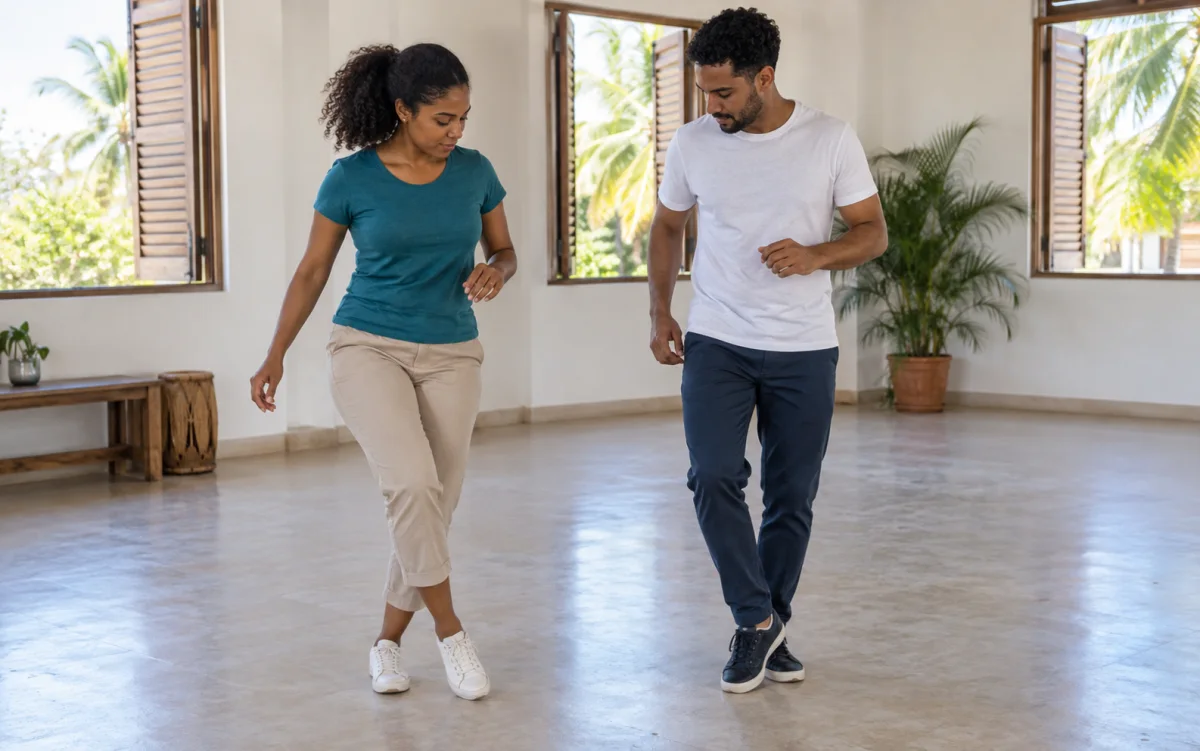
A short practice session between lessons
Spend a few minutes marking the pulse, then practice the basic step slowly without a partner. Repeat to music at a comfortable tempo. Finish by noting one question for your next lesson, such as where your weight should be before the tap.
There's a version of bachata you've probably seen in videos — smooth, theatrical, full of dramatic dips and body rolls. And then there's the version that plays at every Dominican birthday party, Sunday gathering, and neighborhood colmado from Cabarete to Santo Domingo. Those two things are related, but they're not the same. This guide is about the original: Dominican bachata, the social dance that's been part of Dominican culture since the 1960s, and the foundation on which everything else is built.
What Is Dominican Bachata?
Dominican bachata — sometimes called "traditional bachata" or "social bachata" — is the original form of the dance as it developed organically in the Dominican Republic. It's a partner dance performed in closed position, with a characteristic lateral footwork pattern: three weight transfers to the side followed by a tap or syncopated step on the fourth beat. Hip movement occurs naturally as a result of the footwork, not as a separate choreographic element.
The music that drives Dominican bachata is built around the guitar (lead guitar, bass guitar, rhythm guitar), bongo drums, and güira (a metal scraper). The rhythm is steady and driving, with a distinctive guitar picking pattern that gives bachata its unmistakable sound. The lyrics are traditionally romantic and often melancholic — themes of love, loss, longing, and the warmth of Dominican life.
What makes Dominican bachata distinctive as a social dance is its improvisation and responsiveness. Unlike choreographed styles, social Dominican bachata is a conversation between two partners and the music. There's no fixed routine to follow — the leader proposes, the follower responds, and both adapt to the feeling of the song and each other. That quality is what makes it feel so alive when you see it done well.
Dominican Bachata vs Sensual Bachata vs Bachata Moderna
| Style | Origin | Movement | Best for |
|---|---|---|---|
| Dominican Bachata | Dominican Republic, 1960s | Lateral steps, natural hips, grounded | Social dancing, cultural authenticity |
| Sensual Bachata | Spain, early 2000s | Body waves, dips, theatrical connection | Performances, video content |
| Bachata Moderna | International, 2010s | Fusion footwork, open position, cross-body | Dance festivals, intermediate/advanced |
The key distinction for a beginner: Dominican bachata is the style you'll actually use at a Dominican social event. It's what the music was made for. Sensual and moderna styles require a foundation in the basics — starting with those styles is like trying to learn prose writing by starting with poetry. The Dominican original gives you the grammar you'll need for everything else.
How Long Does It Take to Learn Dominican Bachata?
This is the question every beginner asks, and the honest answer is: faster than you expect. Here's a practical timeline based on private lessons with Fraimy Pérez in Cabarete:
After 1 class: You'll know the basic step, understand the rhythm, and be able to move with a partner in closed position. You can step onto a dance floor and not be lost. That's the main goal of the first hour — turning a total stranger to bachata into someone who can participate.
After 3 classes: You'll have the basic step solidly internalized (you stop thinking about it), you'll know three to five combinations (turns, direction changes, crossovers), and you'll start hearing the music differently — feeling where the beat changes, responding to the guitar. This is the stage where bachata starts to feel genuinely enjoyable.
After 5 classes: You have a solid social foundation. You can hold a conversation while dancing (important for social events). You have enough vocabulary to keep a dance interesting for a full song. You'll be fine at any colmado or bachata night in Cabarete.
The big caveat: all of this assumes private lessons. Group lessons in a class of ten people move at a fraction of this speed because the instructor can't correct your specific posture, your specific footwork, your specific way of counting. Private instruction compresses learning dramatically.
Essential Tips for Learning Dominican Bachata as a Beginner
- Listen before you move. Before your first lesson, spend some time just listening to Dominican bachata — traditional artists like Antony Santos, Luis Segura, Raulín Rodríguez. Let the rhythm enter your body before your feet try to follow it.
- Start with posture. In Dominican bachata, posture is everything. A relaxed but upright frame, soft knees, weight slightly forward on the balls of your feet. Your instructor will work on this from minute one.
- Don't rush the count. Beginners instinctively want to rush through the four-count pattern. Resist. The slow version teaches your body the pattern; the fast version just makes it sloppier.
- Feel the hip, don't force it. The hip movement in Dominican bachata is a natural result of the footwork — the hip on the standing leg rises as you step. If you try to consciously move your hips, it looks stiff. If you focus on the footwork, the hips follow on their own.
- Ask questions. A good instructor welcomes them. Asking "why does my footwork feel off?" leads to corrections that would take weeks to figure out on your own.
Private vs Group Lessons: What's Best for Learning Dominican Bachata Quickly?
Group lessons have their place. They're affordable, social, and good for practicing with different partners. But for learning quickly — especially on a vacation with limited time — private lessons are categorically superior.
In a private lesson, 100% of the instructor's attention is on your body, your footwork, your timing, your connection. Every correction is specific to you. You don't wait for ten other people to get through the same explanation. You don't adapt your learning pace to the slowest person in the room.
In a 1-hour private lesson in Cabarete, most beginners cover more ground than they would in three or four group classes. If you're paying for flights, accommodation, and a trip to the Dominican Republic to learn bachata, a private lesson at 2,500 DOP per hour (roughly $42 USD at current rates) is one of the best investments you'll make in your dance education.
Why Learning Dominican Bachata in Cabarete Is Different
You could take a Dominican bachata class in New York, London, or Berlin. Many cities have instructors teaching the style. But learning it in Cabarete is a genuinely different experience — not just better in theory, but better in practice.
The music is everywhere. You hear it walking down the main street. You hear it at the colmado on the corner. You hear it from someone's car window, from a neighbor's open patio. That constant immersion means the rhythm starts to live in you in a way it never would from a playlist. When you go to your lesson, you're not encountering the music cold — you've been absorbing it all day.
The evening social dancing is part of the curriculum in a way that doesn't exist in a dance studio back home. After your lesson, you go to Ojos Locos or Arena Sol and practice with Dominicans who've been dancing this since childhood. That feedback loop — lesson, social dancing, lesson again — is the fastest learning environment on earth for Dominican bachata.
How to Practice Dominican Bachata Between Classes
Between lessons, the best practice isn't in front of a mirror. It's listening. Queue up Dominican bachata playlists — bachata clásica by artists like Antony Santos or Raulín Rodríguez — and just mark the basic step while you listen. Your feet, a few inches of floor, and the music. Do this for 15 minutes before bed each night you're in Cabarete. You'll arrive at your next lesson noticeably more connected to the rhythm than if you'd only drilled the steps.
If you have someone to practice with — a travel partner, a friend at the hotel — even five minutes of slow basic-stepping to music does more for your retention than any amount of thinking about the dance.
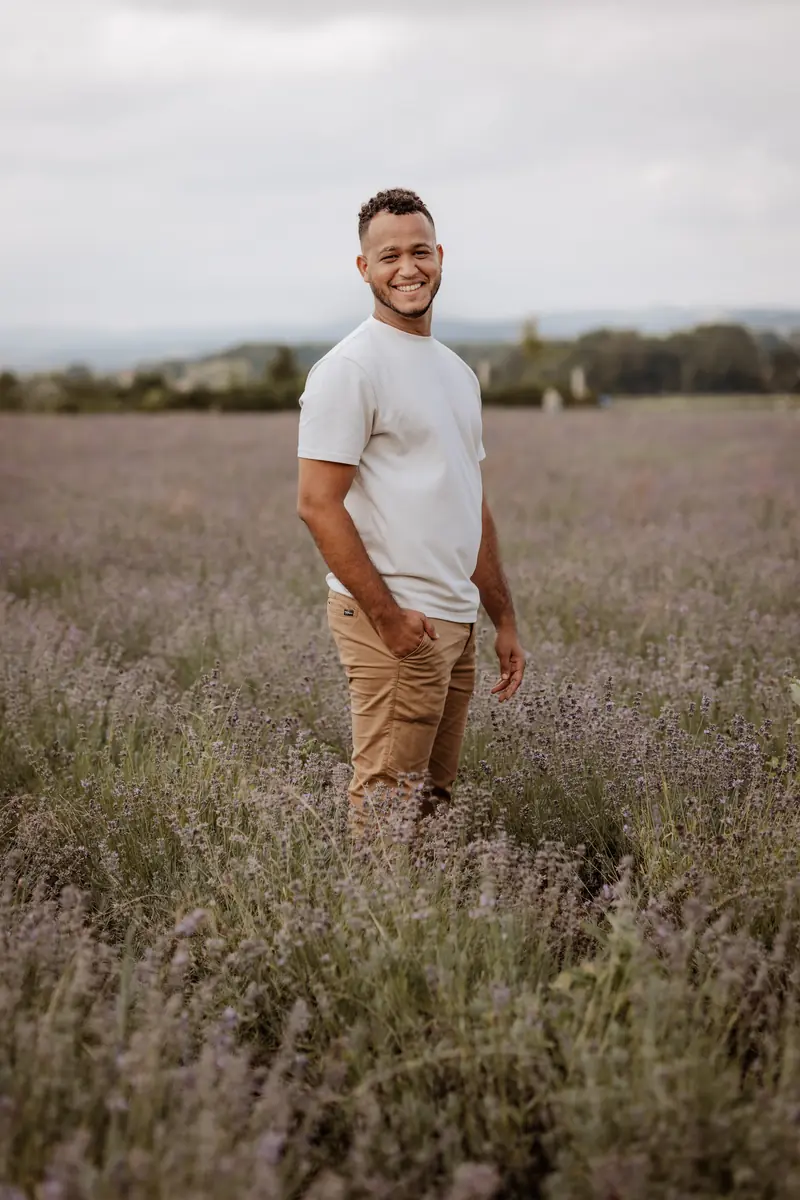
Fraimy PérezDominican instructor from Cabarete. Since 2019 he has taught traditional Dominican bachata, salsa and merengue in private lessons. Meet the instructor →
Ready to dance?
Book your bachata lesson in Cabarete.
Message me on WhatsApp with your dates, level and area. We agree on time and place in Cabarete.